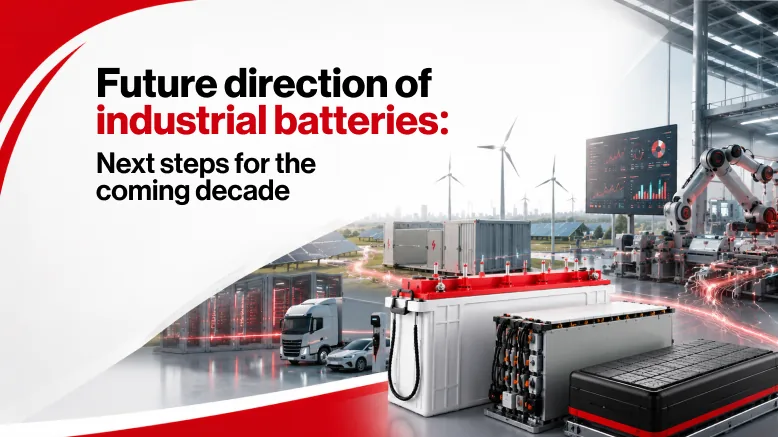
The industrial environment of 2026 has changed dramatically.
With factories becoming smarter and power grids increasingly depending on renewable energy, industrial batteries are no longer simply storage systems.
Modern industrial batteries are evolving into intelligent, high-performance solutions.
Industrial battery suppliers are shifting beyond conventional technologies and moving toward next-generation power systems.
This blog explores key trends shaping the future of industrial energy storage, from artificial intelligence to advanced battery technologies.
The Advent of Smart Industrial battery Systems
One of the biggest trends in 2026 is the transition from traditional battery storage toward smart Industrial battery systems.
These systems are now equipped with advanced Battery Management Systems (BMS), cloud integration and artificial intelligence capabilities.
Predictive Maintenance & Digital Twin
Modern Industrial battery manufacturers now use sensors to monitor system health, temperature, battery discharge cycles and performance in real time.
A Digital Twin system is then created on the cloud allowing users to predict potential failures before they happen.
This significantly reduces downtime in sectors like telecom networks and data centers.
IoT & Remote Monitoring
Smart Industrial battery systems now allow facility managers to monitor battery performance remotely.
Whether operating in Pune, Goa or multiple locations, managers can access complete system data directly from mobile applications.
Automated notifications for maintenance requirements, water top-up reminders and battery replacement schedules ensure uninterrupted performance.
2. New-Age Industrial Batteries: Move Beyond Lithium-Ion
Although Lithium-Ion batteries still dominate the market, newer technologies are rapidly emerging.
These next-generation batteries aim to address challenges related to cost, performance and safety.
Solid-State & Sodium-Ion Batteries
Solid-state battery technology is expected to move beyond research and become commercially practical.
These batteries replace liquid electrolytes with solid materials.
Benefits include improved energy density and significantly reduced fire risks.
At the same time, Sodium-Ion batteries are emerging as affordable alternatives because sodium resources are more widely available.
High Capacity Power Backup Systems
Heavy manufacturing industries increasingly require large-scale power backup solutions.
Flow batteries and modular battery architectures are being designed to support manufacturing lines during extended power failures.
These systems can sustain operations for several hours rather than only a few minutes.
3. The Modern Industrial Lead Acid Battery
Despite advancements in battery chemistry, lead-acid batteries continue to remain a cost-effective and dependable industry standard.
However, today's lead-acid battery technologies have evolved considerably.
Maintenance Free and Graphene-Infused
Modern maintenance-free industrial batteries and VRLA systems now use graphene-enhanced plates.
These materials significantly reduce internal resistance and improve charging efficiency.
Graphene technologies also improve battery lifespan and cycle performance.
- Industrial UPS Battery: High-rate discharge VRLA batteries are ideal for systems requiring instant power delivery.
- Sustainability: Lead-acid batteries continue to be one of the world's most recycled industrial products.
4. Industrial battery Suppliers in 2026
Choosing an Industrial battery supplier in 2026 involves much more than comparing product prices.
Businesses now seek long-term partnerships and technical support capabilities.
Key Expectations from Suppliers
- Technical Guidance: Assistance in designing battery systems balancing upfront cost and long-term return.
- Expandability: Flexible systems supporting future growth requirements.
- On-Site Service: Fast local support and replacement services remain critical.
Impact on Industrial battery Prices
Although prices of advanced technologies like Lithium-Ion and Sodium-Ion continue to decrease, premium lead-acid battery systems still offer the most cost-effective solution per watt for many stationary applications.
Conclusion: A Multi-Chemistry Future
The future of industrial energy storage is unlikely to be a winner-takes-all scenario.
Instead, industries are moving toward a multi-chemistry approach where different technologies solve different needs.
A modern factory may use maintenance-free batteries for emergency systems, smart industrial batteries for server rooms and large-capacity systems for production operations.
Companies like Palsai continue innovating to support both current and future industrial power requirements.
Whether through stationary battery systems or next-generation technologies, the goal remains uninterrupted industrial progress.
Ready to modernize your power infrastructure? Explore advanced Industrial battery solutions today.